How could we improve this service? Your feedback will help.

Construction and trades

Careers in construction and trades

Working in construction and trades offers lots of different roles.

You could:

  • build and repair buildings
  • make sure work meets quality and safety standards
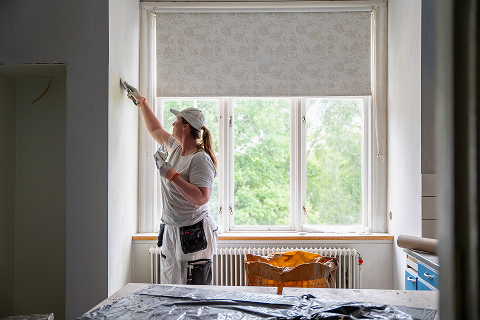
  • decorate inside buildings

There are roles at all levels with lots of routes in. You can find out about the different entry routes you can take on the job profiles.

Decorative.

Examples of careers in construction and trades

Within this sub-sector, you'll find a range of career opportunities.

We've selected a few examples to show the variety of roles, levels and training times. Training time is the amount of time it takes to learn and gain the experience needed to do the job well.

Click on any of the job profiles to view information on entry routes, salary and progressions opportunities, plus much more.


Hear from people working in construction and trades

Hear from individuals working in construction and trades to find out about the jobs they do to see if a career in this sub-sector could be for you.

Meet electrician Luke

Luke's apprenticeship led him to become a net zero delivery manager.

1 minute 30 second watch

View transcript

Hi my name’s Luke. I’m an electrician, and I've just developed into a net zero delivery manager for E.ON.

One thing that I've always been very proud about is doing my job is that it's something that I'm interested in. So having confidence, being a good team player as well, that's really, really important to be a good team player. If you're working alone, you can have these skills that you can find things and work things out, but having a team behind you that's there to support you is really good.

With the job that we do we’re in people's homes. So, you know, it's a… you have different personalities, different types of customers. So you'll have to adapt to, to those people and those people's personalities, especially when you’re working in their home, because it's their home at the end of the day.

I’ve worked on primarily EV charger installations so that would be on building sites and also in residential as well. Me being on site and being an electrician and going through all those little fault finding things because not everything goes perfectly. You know, you can plan it as best as you want, you can test and inspect it. But if you've got a a product that don’t quite play ball you're there using all the skills that you've got to go through, right, I’m going to test it, you know, and find out where that issue is, where that fault is.

You need to have sort of strong mathematical skills as well, because there'll be things that you have to do like cable calculations and working out cable routes and certain efficiencies and things like that. So good strong mathematical skills is another good one.

But, you know, don't be shy if you're somebody who sort of doesn't feel confident in a certain skill because as time goes on, you, you sort of grow into that role. And as long as you've got a nice support network around you, you know you can achieve what you want to achieve.

Watch other videos

Hear from others working in construction and trades to find out more about their role.

Meet kitchen and bathroom fitter Shaun

Shaun is a multi-skilled plumber and joiner who fits kitchens and bathrooms for a housing association.

1 minute 30 second watch

View transcript

Hi, my name’s Shaun Whalley. I work for Yorkshire Housing. I'm a multi-skilled plumber/joiner, so that entails plumbing, fitting bathrooms, fitting kitchens, I fit floors and virtually everything else.

I started working with my father-in-law at the time. Windows, doors, conservatories. Moved up to fitting kitchens and bathrooms then. And then I was with him for 16 years, and then I went from there to Yorkshire Housing. An opportunity come up so I took it. And then been here since 2017.

I could be training somebody up, or I could be fitting a bathroom or I could be fitting a floor, fitting a kitchen. I could be just changing certain things in a property to make it so it goes back out to rent to a new customer.

I bought my house. I literally gutted it straight back to brick, and then I renewed everything in the house and put extensions on. So yeah, it just helps with day-to-day life at home.

Sometimes you've got people working with you which makes it a lot better, because you get to have a bit of a laugh. Got to be able to chat to each other and help each other out when they need it. It's like with other people in the company. If I don't know how to do something, they will come and help me or just talk to me, talk me through it.

I get most of the apprentices because I do have patience and I do have a lot to teach. So, you know, you can pass it on to somebody else as well. So if they want to be in this trade and then you can help them as much as you can, and obviously they'll take over later generation.

When it's finished and you know it's right and it looks good and someone else is going to be using it. It just feels good about it. Satisfying, yeah.

Meet bricklayer Andrew

Andrew gained confidence working as a bricklayer and has developed his machine skills.

1 minute 40 second watch

View transcript

Hello, my name is Andrew Henderson. I'm a bricklayer and I work for Shaws Construction Management.

I was at school and I always wanted to like, work in the construction industry. So I went to college. I went to Gateshead College and I did the NVQ level 1 and 2. I learned how to communicate, how to listen, how to be aware of your surroundings you know. It's hard at first, but once you do it, it’s loads of repetition you know so you just... It's just like riding a bike you know.

You arrive on site, you go to your gaffer, you get your inductions. You come on site and you and you speak to people. It's good to communicate. So you just talk to everybody like all the different trades and it's, everything all comes together, you know.

I’ve been to France, I’ve been to Lyon. I’ve been all over Germany. I’ve been Ireland, Wales, Scotland, all around the UK. I met some awesome people, you know, it's a really good industry to be in you know.

I've gained a lot. I’ve gained how to be super confident. I've gained loads of health and safety, like awareness. I walk on anywhere and just be like, well, you know. I've learnt my machine skills. How to drive cherry pickers to, to everything really you know.

I haven't really got a favourite thing. Everything. I wake up in the morning and just think I'm going to work, you know, like, it's a new thing every day you know. You're not just like laying bricks, you're doing everything. You know, it’s really good.


Example pay ranges in construction and trades

Below are some examples of the pay you could earn from working in different jobs in this sub-sector.

If you’d like to see more salary information for more jobs in this sub-sector, you can view all careers in construction and trades.

We estimate our salary ranges based on different sources. Find out more about the sources we use for salary information.

We'll put a salary as variable if reliable information is difficult to find. This might happen for jobs that are often freelance or have lots of self-employed workers.

Job role Starting pay Pay with experience
Bricklayer £25,000 £45,000
Builders' merchant £23,000 £30,000
Carpenter £24,000 £40,000
Carpet fitter and floor layer £23,000 £36,000
Cavity insulation installer £24,000 £40,000
Ceiling fixer £24,000 £45,000
Construction contracts manager £30,000 £70,000
Construction labourer £23,000 £35,000
Construction manager £27,000 £65,000
Construction plant mechanic £26,000 £44,000
Construction plant operator £25,000 £45,000
Construction site supervisor £30,000 £60,000
Crane driver £25,000 £52,000
Demolition operative £25,000 £43,000
Dryliner £22,000 £43,000
Electrician £26,000 £45,000
Engineering construction technician £26,000 £50,000
Fence installer £23,000 £35,000
Formworker £25,000 £40,000
Glazier £23,000 £40,000

Find out what type of career is right for you

If you're unsure about the type of careers that are right for you, you can take a skills assessment. There are no right or wrong answers when doing a skills assessment. It’s a way to understand yourself better and help you think about your next step.

Take a skills assessment

Explore all sectors

If you’re not sure that this is the right sub-sector for you, you can explore all sectors and discover what each sector has to offer.