How could we improve this service? Your feedback will help.

Agriculture, land and production

Careers in agriculture, land and production

Working in agriculture, land and production offers lots of different roles.

You could:

  • use technologies to manage crop production
  • monitor the soil and plants
  • plan how the land can be used most effectively

There are roles at all levels with many routes in. You can find out about the different entry routes available on the job profiles.

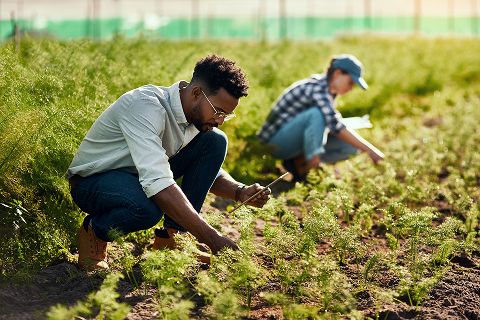
Decorative.

Examples of careers in agriculture, land and production

Within this sub-sector, you'll find a range of career opportunities, from entry level to management.

We've selected a few examples to show the variety of roles, levels and training times. Training time is the amount of time it takes to learn and gain the experience needed to do the job well.

Click on any of the job profiles to view information on entry routes, salary and progressions opportunities, plus much more.


Hear from people working in agriculture, land and production

Hear from individuals working in agriculture, land and production to find out about the jobs they do to see if a career in this sub-sector could be for you.

Meet farm worker Thomas

Thomas works as a general farm worker on an arable farm.

2 minute watch

View transcript

I'm Thomas Gent and I work on a farm here in South Lincolnshire.

It's an arable combinable crop farm.

When I first got a role in farming, I was definitely doing some of the more basic jobs, so kind of cleaning the grain store, helping the more experienced guys with the machinery maintenance, kind of learning the ground roots I guess.

But then as I progressed and became a bit more experienced, I would say year two, three onwards, I've advanced to you know, getting the sprayer qualification and doing the spraying myself and now even driving a combine in harvest.

I mostly enjoy being outside. You know, I'm definitely an outdoors sort of person I'm not very good at sitting in front of a computer.

We use a lot of technology on the farm. All of our tractors are GPS fitted. So all of the tractors run on auto steer and the modern machinery, the combines and the sprayers all have screens and computers built in and there's a huge amount of controls we fit to them. So I would say technology is probably one of the highest skills that I need as a farm worker.

Everybody needs a farmer. Everybody needs food and working in agriculture we're obviously producing some really healthy British food to put on the plate.

And so that's really why I love it and why I think it's really important that more people get involved.

I would say definitely look at a career in agriculture. There's so many various different roles and there's definitely gonna be something that fits you and the best bit is you just get to be outside. And there's lots going on. There's lots of different skills required all the way from kind of technology work all the way to animal animal care.

I really enjoy being a farm worker and working on farm every day. It's really nice to be outside. The role changes so much throughout the year, depending on the seasons and the weather. And it's definitely something that I would recommend everybody to get involved in and look at as an option for them.

Watch other videos

Hear from others working in agriculture, land and production to find out more about their role.

Meet crop technician Will

Will works as a crop technician, giving advice on crop protection.

1 minute 40 second watch

View transcript

Hi, I am Will Oliver and I'm really passionate about the technical side of crop production on this farm.

So I grew up on the family farm and from there I went and did a degree in Agriculture and Crop Protection at Harbor Adams.

That gave me the confidence to do my Basis and Facts, which are the qualifications you need to become a qualified agronomist.

I advise on crop protection products and fertiliser recommendations.

Typical working week can change throughout the year.

You try and learn as you go along, but there's always something different that throws a curve ball at you.

So we're using satellite imagery. We can monitor things in real time now, but nothing really beats getting out in the field, walking the field.

The technical side of crop production, what I enjoy the most is that it shows the results. So things like yield maps, having that picture painted for us on a computer, so to speak, it stays there forever really.

Agriculture, horticulture, all elements of food production are hugely important in protecting our environment but they've gotta work hand-in-hand.

So we're doing things like not using insecticide on the farm for six years, cover cropping, improving soil health, monitoring our soils, organic manures, a more diverse crop rotation.

There's lots of things going on that we do all the time to be more sustainable.

Meet ecologist Rob

Rob is a professor of tropical ecology. He teaches courses and leads a research group on tropical ecosystems.

1 minute 40 second watch

View transcript

Hello, I'm Rob, Rob Marchant, a professor of tropical ecology at the University of York.

So there's a teaching element, and I lead a couple of courses. So one on land use change and land use management. One on sort of field based teaching. Research, and for me at the moment that's probably the, the biggest part of it. So I run a research group around tropical ecosystems.

I very much started off say in this field of paleoecology, going to swamps, taking cores of sediment. Coming back, analysing them in the lab. Understanding and describing those past changes. We still do quite a lot of that work still, that fundamental research. But we also are increasingly, rather than looking down and into sediments and back through time, we're looking forward and trying to develop participatory scenario approaches, so bringing people together.

Being able to be flexible and to listen to people and to listen to, you know, some of those challenges and be able to be open to those new ideas that come through.

One of the key things is as an ecologist, as a paleoecologist, you know, we now work with modelers, we work with archeologists, we work with anthropologists, we work with historians, we work with sort of social scientists, we work with theatre groups, we work with artists.

It's really important that we have people with the skills who know what those challenges are going to be and how we can work with nature. How we can work with ecosystems, how we can work with landscapes, to navigate those futures.


Example pay ranges in agriculture, land and production

Below are some examples of the pay you could earn from working in different jobs in this sub-sector.

If you’d like to see more salary information for more jobs in this sub-sector, you can view all careers in agriculture, land and production.

We estimate our salary ranges based on different sources. Find out more about the sources we use for salary information.

We'll put a salary as variable if reliable information is difficult to find. This might happen for jobs that are often freelance or have lots of self-employed workers.

Job role Starting pay Pay with experience
Agricultural contractor Variable Variable
Agricultural engineer £28,000 £50,000
Agricultural engineering technician £24,000 £38,000
Agricultural inspector £25,000 £45,000
Agronomist £27,000 £60,000
Arboricultural officer £25,000 £40,000
Beekeeper Variable Variable
Bin worker £24,000 £30,000
Cemetery worker £23,000 £28,000
Countryside officer £22,000 £34,000
Countryside ranger £20,000 £28,000
Crop technician £24,000 £38,000
Farm worker £20,000 £36,000
Farmer £24,000 £50,000
Fish farmer £23,000 £35,000
Fishing boat deckhand £22,000 £30,000
Florist £22,000 £28,000
Forest works manager £30,000 £52,000
Forestry worker £26,000 £32,000
Gamekeeper £24,000 £30,000

Find out what type of career is right for you

If you're unsure about the type of careers that are right for you, you can take a skills assessment. There are no right or wrong answers when doing a skills assessment. It’s a way to understand yourself better and help you think about your next step.

Take a skills assessment

Explore all sectors

If you’re not sure that this is the right sub-sector for you, you can explore all sectors and discover what each sector has to offer.